For patients suffering from severe tooth loss, unstable dentures, or failing dental work, full mouth dental implants offer a life-changing solution. Portugal has emerged as one of Europe’s leading destinations for this advanced treatment, combining medical expertise, modern clinics, and an efficient treatment protocol specifically adapted for international patients.
One of the most important questions patients ask is simple: how long does the full mouth dental implant process take in Portugal?
The answer is both reassuring and precise. The treatment is performed in two separate trips, with immediate loading of a fixed temporary prosthesis during the first visit. This means patients do not leave Portugal without teeth. Instead, they return home with a stable, functional, and natural-looking fixed smile while the implants heal.
Understanding the full timeline and process helps patients prepare confidently and eliminates uncertainty about travel, recovery, and final results.
Why timeline matters for international patients
For patients traveling from the UK, Ireland, the United States, or Canada, planning is essential. Full mouth dental implants require surgical precision and biological healing time, but modern implantology protocols have significantly optimized the process.
Unlike outdated methods that required patients to remain edentulous for months, current techniques allow immediate restoration of function and aesthetics.
Portugal’s structured two-trip protocol offers three critical advantages. Patients receive fixed teeth immediately after surgery. Healing occurs safely at home between visits. The final prosthesis is placed only after complete biological integration.
This approach ensures both medical safety and patient comfort, while minimizing travel time and disruption to daily life.

Overview of the full mouth implant protocol in Portugal
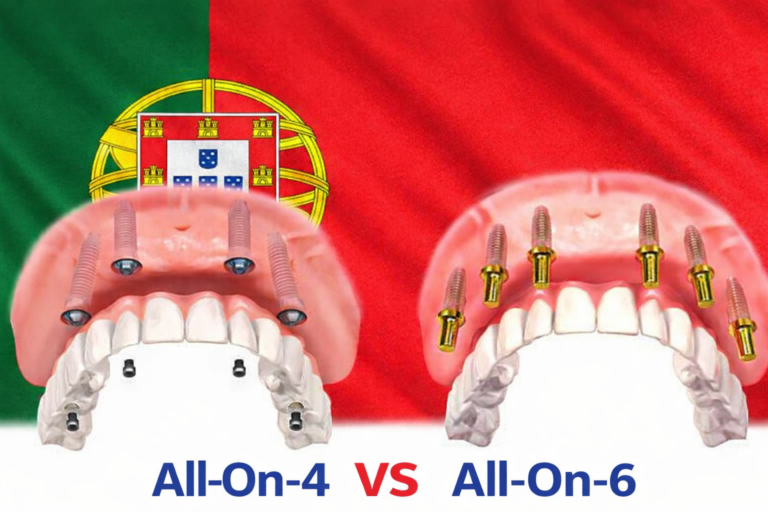
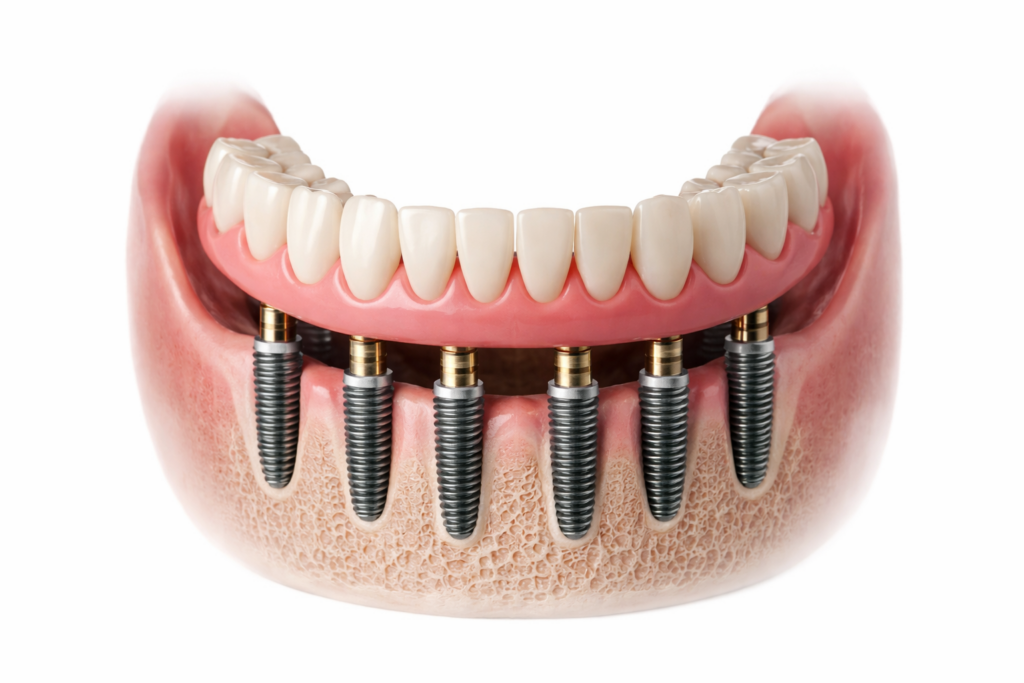
Full mouth dental implants typically involve placing four to six implants per arch using advanced techniques such as All-on-4 or All-on-6.
These implants act as artificial tooth roots and support a full fixed prosthesis. The treatment is divided into two main stages.
First trip: surgical placement of implants and delivery of a fixed temporary prosthesis.
Healing phase: osseointegration, during which implants fuse with the jawbone.
Second trip: placement of the final zirconia prosthesis.
This structured protocol allows immediate restoration of teeth while ensuring long-term stability.
First trip: consultation, surgery and immediate temporary teeth
The first visit to Portugal is the most important phase of the treatment. It typically lasts between 5 and 7 days.
Day 1: clinical examination and digital planning
Upon arrival, the process begins with comprehensive diagnostics. This includes 3D CBCT imaging, digital impressions, and a full clinical examination.
The implant surgeon evaluates bone volume, anatomical structures, and determines optimal implant positioning. Modern digital planning ensures maximum precision and predictability.
This step is critical because it allows the surgeon to prepare the immediate loading prosthesis in advance.
Day 2 or 3: implant surgery
The surgical procedure involves placing four to six titanium implants in each arch, depending on the treatment plan.
Advanced techniques such as angled implants allow surgeons to maximize existing bone and often avoid bone grafting. This reduces recovery time and simplifies treatment.
The procedure is performed under local anesthesia, often with sedation for patient comfort.
Surgery typically lasts between 2 and 4 hours per arch.
Same day or within 48 hours: delivery of fixed temporary prosthesis
One of the most reassuring aspects of the Portuguese protocol is immediate loading.
Patients do not leave without teeth.
Within 24 to 48 hours after surgery, a fixed temporary prosthesis is attached to the implants. This prosthesis is fully functional and aesthetically natural.
Patients can smile, speak, and eat soft foods immediately.
This immediate restoration dramatically improves psychological comfort and quality of life.
Immediate loading: why you leave Portugal with fixed teeth
Immediate loading is possible thanks to modern implant design and precise surgical techniques.
Primary stability is the key factor. This refers to the mechanical stability of the implant in bone at the time of placement.
When sufficient stability is achieved, implants can safely support a temporary fixed prosthesis.
Portugal’s leading implant clinics use premium implant systems and strict protocols to ensure predictable immediate loading success.
This approach offers significant advantages.
Patients never experience a toothless period.
Facial appearance is preserved.
Speech remains normal.
Psychological confidence is maintained.
The temporary prosthesis also helps guide gum healing and shapes the final aesthetic outcome.
Healing phase between the two trips
After returning home, the most important biological phase begins: osseointegration.
Osseointegration is the process by which the jawbone fuses with the titanium implants. This creates a permanent and stable foundation for the final prosthesis.
This healing phase typically lasts between 3 and 6 months.
During this time, patients live normally with their fixed temporary teeth.
The temporary prosthesis is strong and functional, but certain precautions are recommended.
Patients should avoid extremely hard foods during early healing. Regular hygiene must be maintained. Follow-up communication with the clinic ensures proper monitoring.
The vast majority of patients experience smooth and uneventful healing.
Second trip: final zirconia prosthesis placement
The second visit to Portugal focuses on delivering the permanent prosthesis.
This visit usually lasts between 5 and 7 days.
Digital impressions and precision fitting
Modern digital scanning ensures perfect adaptation of the final prosthesis.
Unlike removable dentures, the final restoration is fully fixed and custom designed for each patient.
The prosthesis is typically made of zirconia, one of the strongest and most aesthetic materials in modern dentistry.
Zirconia offers exceptional durability, natural appearance, and long-term stability.
Final prosthesis placement
Once the final prosthesis is ready, it is securely attached to the implants.
The result is transformative.
Patients regain full chewing function.
Speech becomes completely natural.
The smile appears realistic and harmonious.
Confidence is fully restored.
This prosthesis can last decades with proper care.
Total timeline: realistic expectations for international patients
Understanding the full timeline helps patients prepare with confidence.
Initial remote consultation and planning: a few days
First trip: 5 to 7 days
Healing phase: 3 to 6 months
Second trip: 5 to 7 days
Total active treatment time in Portugal: approximately 10 to 14 days across two trips.
Total biological timeline: approximately 4 to 8 months.
This makes Portugal one of the most efficient countries for full mouth implant rehabilitation.
Why Portugal offers one of the most efficient implant timelines in Europe
Portugal combines several critical advantages that optimize treatment timelines.
Highly experienced implant surgeons perform these procedures daily.
Modern clinics use advanced digital workflows that accelerate treatment planning.
Immediate loading protocols eliminate the need for removable temporary dentures.
Strict medical standards ensure safe and predictable outcomes.
For international patients, Portugal also offers logistical efficiency, short travel distances from Europe, and excellent medical infrastructure.
Who is eligible for immediate load full mouth implants
Most patients with severe tooth loss are eligible for this treatment.
Even patients with significant bone loss can often receive implants using advanced techniques such as angled implant placement.
Eligibility depends on several factors.
Bone quality and volume
General health condition
Absence of uncontrolled systemic disease
Commitment to oral hygiene
A detailed evaluation determines suitability.
The vast majority of patients qualify for immediate loading protocols.
Why the two-trip protocol ensures long-term success
The two-trip protocol is designed to maximize both safety and results.
Immediate loading restores function and aesthetics immediately.
The healing phase allows complete biological integration without stress.
Final prosthesis placement occurs only after full stabilization.
This structured approach dramatically reduces complications and ensures long-term success.
It represents the gold standard in modern implantology.
What international patients should do before traveling
Preparation begins with a remote consultation.
Patients typically send panoramic X-rays or CBCT scans.
The clinic evaluates eligibility and prepares a personalized treatment plan.
This allows precise scheduling and eliminates unnecessary delays.
Proper preparation ensures a smooth and efficient experience.
Full mouth dental implants Portugal timeline explained for international patients
Portugal offers one of the most advanced and efficient full mouth dental implant protocols available today.
Patients benefit from immediate fixed temporary teeth during their first visit, eliminating the psychological and functional challenges traditionally associated with implant treatment.
The healing phase occurs comfortably at home, followed by placement of a permanent zirconia prosthesis during the second visit.
This two-trip protocol ensures optimal biological integration, long-term stability, and exceptional aesthetic results.
For international patients seeking a reliable, structured, and efficient solution, Portugal represents one of the safest and most predictable destinations for full mouth dental implant rehabilitation.
SOURCES:
International Team for Implantology
Explains the full dental implant process, healing phase, and osseointegration timeline for full arch restorations.
European Association for Osseointegration
Provides evidence-based information on implant healing, immediate loading, and long-term implant success.
National Health Service UK
Describes implant procedure stages, healing duration, and long-term expectations for patients receiving implants.